
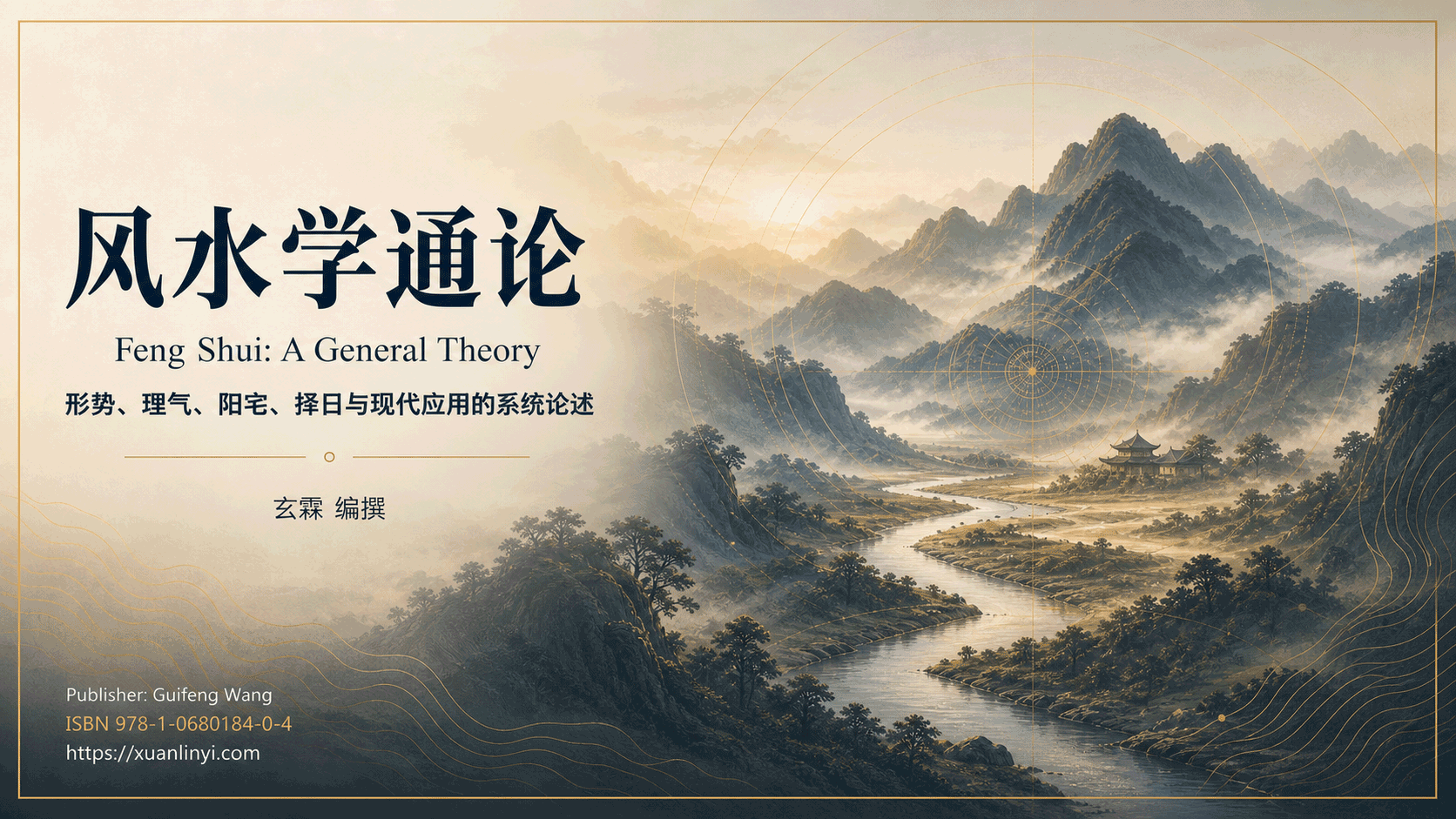
Detailed Description
Throughout this book, the terms “feng shui”, “kanyu”, and “dili” are used interchangeably. “Feng shui” is the name most familiar in everyday language. “Kanyu” is the more technical term traditionally used within the Chinese cosmological arts. “Dili”, widely found in classical writings, refers more broadly to the study of landforms and waterways, the siting and construction of dwellings and tombs, spatial orientation, and the movement and configuration of qi. In this book, the three terms do not denote separate disciplines. They are different names for the same body of knowledge, each shaped by its own historical and cultural context.
The approach adopted here takes “xingshi”—the reading of spatial form and configuration—as its foundation; “liqi”—the cosmological analysis of orientation, timing, and qi—as its operative method; and human habitation as its ultimate concern.
“Xingshi” encompasses the visible and tangible features of a place: mountains and waterways, the form of towns and cities, roads and entrances, “mingtang” or open gathering spaces, “shuikou” or points of passage and outflow, the scale and massing of buildings, and the organization of interior space. It is concerned not merely with the shape of individual objects, but with the larger spatial relationships they create—height and depth, enclosure and openness, approach and departure, concentration and dispersal.
“Liqi” concerns the cosmological systems through which orientation, time, and environmental change are interpreted and calculated. These include yin and yang, the Five Phases, the Eight Trigrams, the “Hetu” and “Luoshu” diagrams, the Heavenly Stems and Earthly Branches, directional correspondences, the Three Cycles and Nine Periods, the movement of the Nine Stars, the matching of individuals and dwellings, and the selection of dates and seasons.
The two are mutually dependent. Where physical features do not compose a coherent spatial configuration, “liqi” has no concrete setting in which to operate. Where orientation and timing are out of phase, even a favorable physical setting may not come into effect smoothly or consistently. “Xingshi” and “liqi” therefore enable one another while also setting limits on one another.
This book does not treat mystery as a measure of intellectual value, nor does it regard wholesale rejection as a sign of clear thinking. The historical traditions of feng shui are too complex for either approach. They contain accumulated experience in habitation, terrain assessment, architectural ethics, and ecological adaptation. They also contain cosmological calculation, symbolic analogy, rivalry between schools, and the extravagant claims of popular practitioners. A general study of feng shui should preserve the internal structure of its ideas while remaining equally clear about their limits. Whenever questions of efficacy arise, this book explains how they are understood and assessed within traditional feng shui theory, without making absolute promises.
The discussion draws on classical texts, commentaries, case studies, and modern scholarship relating to feng shui, “kanyu”, “dili”, Xuan Kong, San He, the Eight Mansions system, residential feng shui, the “luopan” compass, and traditional date selection. These materials are brought together within the broader framework of feng shui knowledge. Although the sources are wide-ranging, the purpose is not to substitute compilation for argument, but to clarify the tradition’s central concepts, theories, methods, and limitations.
Any contemporary reconsideration of feng shui must take account of changes in urban density, housing design, transportation systems, property management, indoor technology, and family life. Earlier practitioners worked primarily with mountains, rivers, villages, and open landscapes. Today, many people live and work in high-rise apartments, elevator buildings, shopping centers, office towers, business parks, and dense road networks.
The spatial principles have not disappeared, but the forms in which they appear have changed. Questions of height and depth, enclosure and openness, approach and departure, or gathering and dispersal can now be observed through pedestrian and vehicle movement, sightlines, daylight, ventilation, noise, drainage, fire safety, and privacy. What earlier texts described through the language of mountains and waterways may therefore reappear in modern settings as a complex relationship among buildings, infrastructure, environmental conditions, and patterns of human activity.
For feng shui to remain genuinely useful, it should help people determine whether a place is stable, well lit, accessible, comfortable, and suitable for long-term living or productive work. At the same time, it must acknowledge the practical constraints imposed by structural conditions, building regulations, public safety, health, and individual ways of life.
Traditional feng shui can still provide a meaningful way of reading the environments in which people live. Its continuing relevance, however, depends on translating principles once applied to mountains and waterways into the realities of everyday life, and on understanding the traditional language of good and bad fortune in terms of spatial order, temporal rhythm, and human physical and psychological experience.